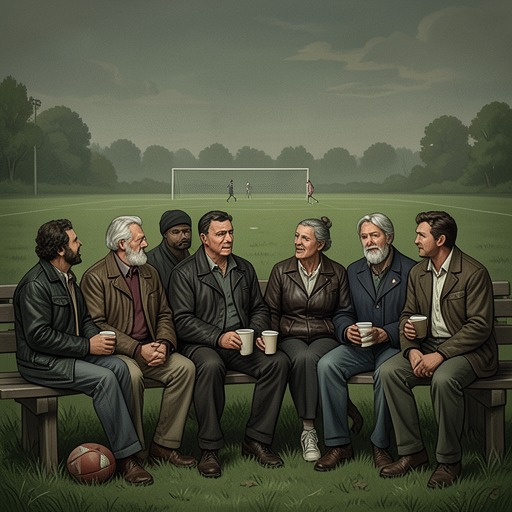
Anna
Player Manager: A Sports Progression FantasyAnna is an elderly resident of the care home who becomes a vivid and unexpectedly active presence in Max Best’s life. Initially encountered beside Max’s seriously ill mother, she appears physically frail but possesses a commanding personality, a sharply observant mind, and an unusual spiritual connection with Solly. Her later recovery, return to walking, involvement with the Met Heads, and continuing conversations about football give her a role far beyond that of a fellow resident: she becomes a witness, confidante, eccentric authority, and recurring bridge between the care home and Max’s increasingly complicated football career.
Identity and Introduction
Anna is introduced when Max visits the care home and goes to find her after hearing her name. She lies on a medical bed in the centre of the room and is visibly much older and physically sicker than Max’s mother. His first impression reduces her to the familiar outline of an old woman with white hair, but that impression is immediately unsettled by her voice and presence. She gives a clear command for him to enter, then tells him to stop only a few steps inside, establishing control over the encounter before Max has understood who she is.
Her face soon becomes distinctive to Max, especially because of the wrinkles around her nose and the shape of her lips. More important than these physical details is the force of her personality. She has what Max recognizes as a powerful aura: the energy of someone who would thunder around a garden or organize fetes. Even from a medical bed, Anna is not presented as passive or diminished. Her physical condition and social force pull in opposite directions, and that contrast defines her presence throughout the story.
Anna is also identified as German. She notices Max’s accent and later appears as a ginger-haired German winger during a football training session. The narrative therefore gives her two apparently separate identities—elderly care-home resident and active football player—without treating either as a disguise or a contradiction. Her body may be recovering, but her capacity for participation remains intact.
Spiritual Authority and Life in the Care Home
Anna’s relationship with Solly is central to the way she is characterized. When Max treats the dog as though he were merely an animal, Anna warns that he is confusing Solly with a horse and insists that Solly is “a very spiritual animal.” In her account, he has seen many things, sees many things, and is never wrong. The statement may be eccentric, comic, or genuinely prophetic; the novel leaves the supernatural status of her claims uncertain, but it gives Anna a firm interpretive authority over Solly.
Anna also describes Max’s mother as possessing latent spiritual gifts and a real talent for the occult. She says that the two women spend evenings stargazing, exploring tarot, and discussing the mysteries of the universe, while simultaneously lamenting the mother’s fondness for the most reductive television shows. This mixture of esoteric seriousness and sharp social judgment captures Anna’s conversational style. She can move from the mysteries of existence to a dismissive observation about popular entertainment without treating the change of subject as strange.
Her connection with Max’s mother develops through ordinary shared activity as well as spiritual speculation. At one point, the four of them—Max, his mother, Anna, and Solly—play cards together. Solly receives no hand and instead lies on Max’s mother’s feet, occasionally standing, turning around, and settling again. The scene makes the care home feel less like a place of institutional isolation than a temporary domestic circle, with Anna participating as a companion and Solly as an almost-human presence within the group.
Anna’s resilience is also reflected in her willingness to receive company when she is unwell. During one visit, she is in bed and looks weary, but says that she does not mind having guests. Later, when Max visits with Raffi and Shona, Anna’s condition has visibly improved. She is up and moving with the aid of a walking stick fitted with oversized ferrules. Her voice has lost some of its former power, yet she remains unmistakably herself, barking Max’s name and immediately reminding him that Solly misses his walks.
Entrance into Football
Anna’s football identity emerges when Max brings a group of visitors and players into contact with Beth’s team. During the training session, she is described as a ginger-haired German winger, alongside Eva, a very tall and gangly defender. The description shifts Anna from the care-home setting into the athletic world without erasing the earlier version of her. She is not merely discussed as someone connected to football; she is placed on the pitch as a player.
The clearest evidence of her role comes in the seven-a-side formation for the Met Heads. The team lines up in a 2-2-2 shape, while the opposing side imitates Manchester City’s 2-3-1. Anna plays up front for the opposing team, with Jackie in goal, Eva and Bex in defence, Max, James, and Kisi in midfield, and Anna as the attacking outlet. Her position matters narratively because it places her at the sharp end of the formation, not as a symbolic mascot or peripheral participant but as the player expected to convert the team’s movement into danger.
The attacking patterns built around her show that the other players take her seriously. In one planned move, Jane’s pass is intended for Bex to touch on to Anna, who can then choose between shooting and passing to Eva. Eva’s run is designed to reach the far post, so Anna becomes the decision point in a coordinated attack. The play reveals both her technical relevance and the team’s trust in her judgment: she is given options rather than a single mechanical instruction.
Anna is also involved in a rapid passing sequence in which Max calls her name and sends a diagonal ball toward her. Nobby’s interception changes the immediate recipient, and the ball moves through Lula and Bella before Sophia attacks the space in front of goal. Anna’s presence remains part of the intended attacking structure even when the move develops differently. Football in these scenes is not simply an activity Anna happens to join; it is one of the arenas through which her alertness, mobility, and capacity to belong are made visible.
Relationships and Recurring Presence
Anna’s closest established relationship is with Max’s mother, whom she treats as both a friend and a spiritual companion. Their evenings of stargazing and tarot, their card games, and their shared place in the care home create a form of companionship that supplements the family bond Max is trying to maintain. Anna’s presence makes his mother’s world larger than illness: the care home contains friendship, argument, occult speculation, television criticism, and football conversation.
Her relationship with Max is more confrontational and more useful than conventionally sentimental. She notices him, tests him, and speaks to him with an authority that does not depend on his new football status. When she is recovering, her first significant reminder is not about Max’s career but about Solly’s walks. The rebuke draws him back toward practical care and toward the dog whose spiritual importance she has already established.
Anna’s connection with the football group is likewise active rather than ornamental. She appears among Beth’s players, occupies a tactical position, and participates in plans involving Jane, Bex, Eva, and the wider team. Her role also overlaps with Max’s attempts to act as an agent. When Max considers whether to take another person on as a client, he consults Solly, whose spiritual authority has been defined by Anna. Even when Anna is not the speaker in that exchange, her earlier account of Solly shapes the way Max interprets the dog’s judgment and links his professional decisions to the care-home world.
The contrast between Anna’s settings produces much of her effect. In the care home she is associated with beds, illness, walking aids, and the companionship of a psychic dog. On the pitch she is a winger and an attacking option within a structured formation. Neither setting cancels the other. Instead, the juxtaposition insists that age, sickness, eccentricity, and sporting competence can coexist in the same character.
Change, Continuity, and Narrative Significance
Anna changes physically over the course of the narrative, moving from a medical bed to walking with a stick. Her voice is weaker when Max sees her recovering, but her personality has not been weakened into silence. The barked greeting and complaint about Solly show continuity beneath the physical change: recovery restores movement without altering the force of her attention.
Her later appearance during Max’s viewing of Liverpool’s 1–0 victory over Manchester City is quieter but equally revealing. Max sits with his mother and Anna in the care home while Solly is also present, and they listen to the laptop broadcast together. The match is described as high quality and decided by fine margins, with noisy and intense Liverpool supporters, yet it fails to stir Max emotionally. Anna’s presence frames this detachment. Football may have become Max’s professional world, but in the care home it is still one shared sound among several forms of companionship, and the emotional centre of the scene lies in the people and animal around him rather than in the result.
Anna therefore functions as a counterweight to Max’s tendency to convert experience into footballing information. He may struggle to read tactical formations and may construct new identities as scout, agent, or gaffer, but Anna remains associated with forms of knowledge that cannot be reduced to a screen: accent, aura, spiritual intuition, illness, recovery, friendship, and the physical fact of walking a dog. Her uncertainty is part of her significance. The narrative never requires a final decision about whether her occult claims are true. It is enough that Solly’s apparent insight, Anna’s confidence, and Max’s growing dependence on football all meet around her.
Anna’s enduring role is consequently both comic and serious. She expands the novel’s idea of who can be a football participant, preserves a social world for Max’s mother, and gives the care home a living connection to the pitch. Her movement from bed to field and back into shared match-watching makes her a figure of continuity: illness changes what she can do, but not her appetite for judgment, companionship, or involvement. Through Anna, the story treats football not as an enclosed professional system but as something that can pass through family, friendship, spirituality, recovery, and the ordinary rituals of a shared room.